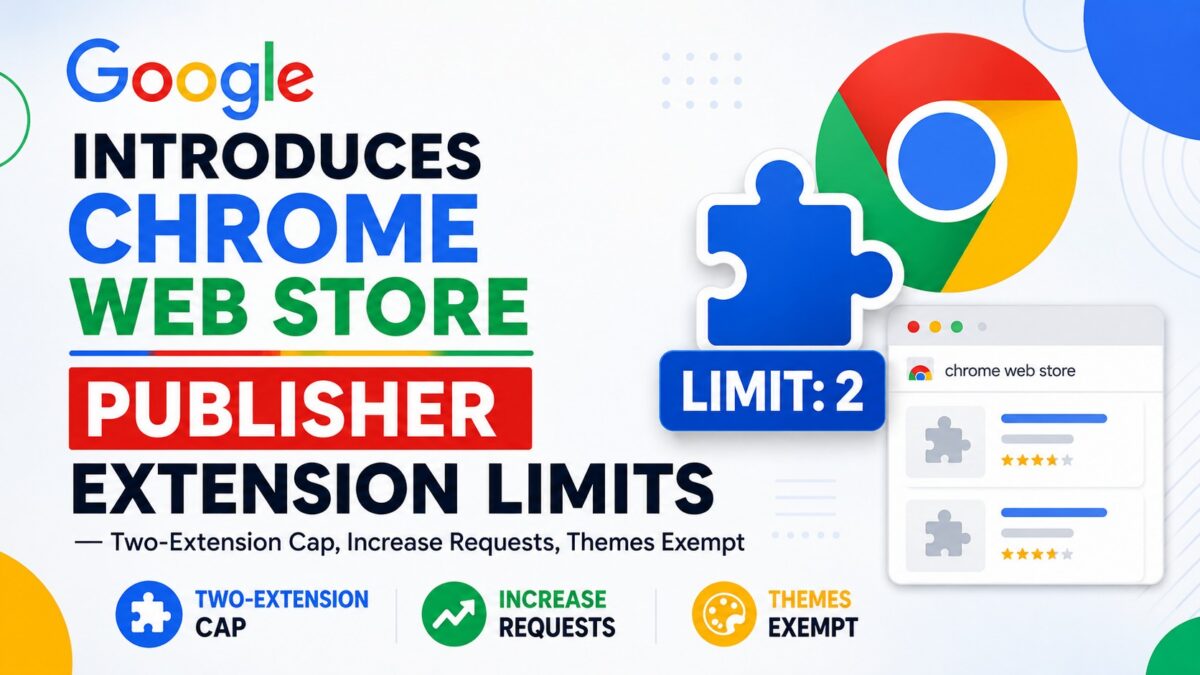
Google has introduced new limits on how many extensions a developer can publish on the Chrome Web Store, effective August 20, 2026. Google frames the change as part of an ongoing effort to support a high-quality ecosystem and improve review times.
Key details include a default two-extension cap for new publisher accounts, a request-for-increase option inside the Developer Dashboard, and specific tenure and engagement criteria behind approval decisions. Themes are not covered by this limit.
The Two-Extension Cap
When a developer first creates a publisher account on the Chrome Web Store, Google now limits that account to a maximum of two published extensions. The current limit for any account is visible on the Developer Dashboard.
Google notified existing developers of the change through an email sent around the August 20, 2026 rollout, stating that a publisher’s extension limit “might have been adjusted” and pointing them to the dashboard to check their current number. Google’s email adds that no action is required from developers as a result of the change itself.
Requesting an Increase
Developers who reach their limit can request an increase directly through the Chrome Web Store Developer Dashboard. According to Google, most requests receive an immediate decision based on a number of criteria. If Google asks a developer to submit a support case instead, Google states it aims to respond within a few days.
When a request for an increase does not qualify, Google lists two reasons that may apply:
- The developer’s currently published extensions need higher sustained engagement.
- The developer’s publisher account does not currently meet Google’s tenure and activity requirements.
Google states that a developer will be told the specific reasoning behind a denied request.
Why Now
Google’s own communication attributes the change to supporting “a high-quality ecosystem” and improving review times, without naming a specific trigger. Independent of Google’s stated reasoning, the change arrives at a time when the Chrome Web Store has seen a rise in low-effort, AI-generated (“vibe-coded”) extension submissions flagged across the developer community, a pattern that would plausibly strain manual review capacity and push a publisher toward tighter default limits. Google has not confirmed this as a factor.
What’s Exempt
This limit does not apply to themes. A publisher account can continue to publish themes on the Chrome Web Store without being counted against the two-extension cap.
Where to Get Help
Google’s email points developers toward its developer documentation for more detail on the change, and invites feedback through the chromium-extensions mailing list. Google states that developers with questions can also reach out through its official support channels.
Related Articles on Tech Stories India
- Google’s Antigravity 2.0 Built a Working OS with AI Agents — 93 Subagents, Gemini 3.5 Flash
- Google’s Gemini Intelligence on Android — Multi-Step App Automation, Rambler, Create My Widget Coming First to Galaxy S26 and Pixel 10
- Google Snapseed 4.0 Launched – One-tap AI Masking, Bloom & Halation Cinematic Tools – Listed on Play Store
- Acer Chromebook Spin 314 CP314-2HN-30V1 Convertible Laptop Listed on Amazon US
Note: Details above are based on Google’s Chrome Web Store developer communication and support documentation dated around August 20, 2026, and are subject to change. Final policy details, criteria, and appeal processes may be updated by Google at any time. Verify against Google’s official Chrome Web Store developer channels before relying on any specific detail.
Disclaimer: This post summarizes a Google product/policy announcement for informational purposes. It is not affiliated with or endorsed by Google.