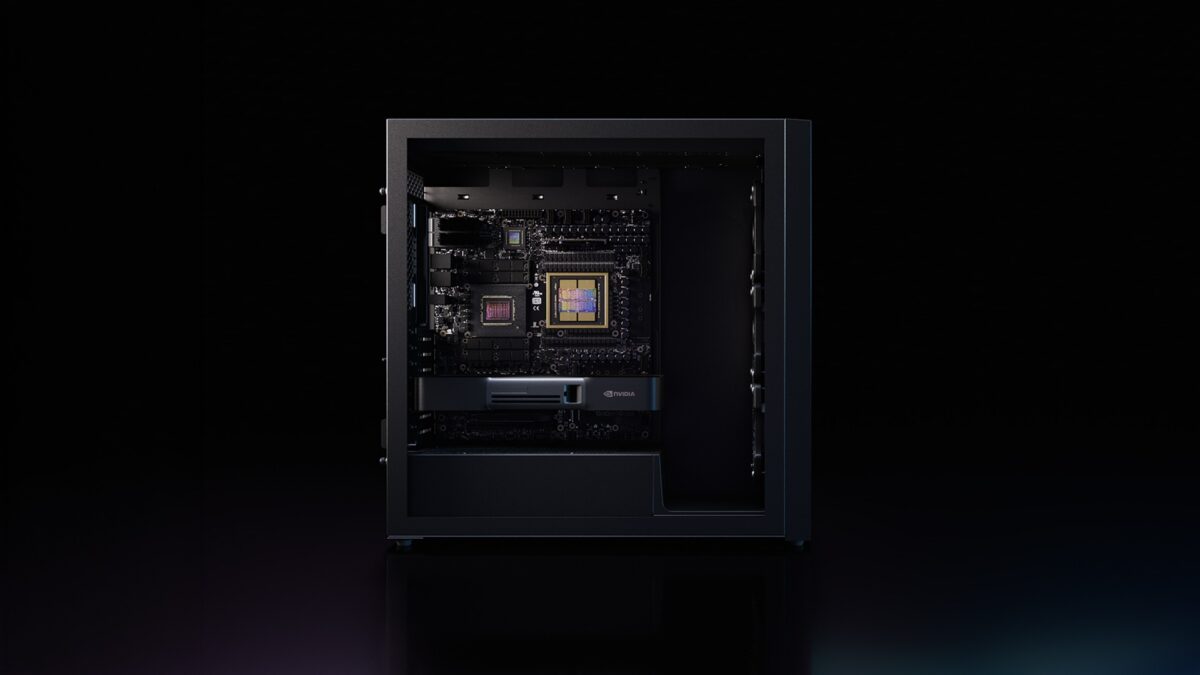
NVIDIA has announced DGX Station for Windows, a deskside AI supercomputer designed to run frontier AI models of up to 1 trillion parameters locally, directly within the Windows ecosystem. Announced at NVIDIA GTC Taipei and developed in collaboration with Microsoft, DGX Station for Windows is built on the NVIDIA GB300 Grace Blackwell Ultra Desktop Superchip and is expected to be available from ASUS, Dell Technologies, GIGABYTE, HP, MSI, and Supermicro in Q4 2026.
The system targets enterprise developers, researchers, engineers, designers, and data scientists who need frontier-class AI compute — historically only available in data centers running Linux — connected directly to the Windows applications and workflows they already use. DGX Station for Windows can run hundreds of agents simultaneously, supports pretraining and fine-tuning of large models, and scales workloads seamlessly to GB300 systems in the data center or cloud.
Key capabilities include up to 20 petaflops of FP4 AI performance, up to 748GB of coherent memory, 800Gb/s networking via ConnectX-8 SuperNIC, support for Windows security primitives and NVIDIA OpenShell, and optional pairing with an NVIDIA RTX PRO 6000 Blackwell Workstation GPU for physical AI workflows combining frontier compute with ray-traced visualization.
Quick Links
GB300 Grace Blackwell Ultra — The Superchip Inside
DGX Station for Windows is powered by the NVIDIA GB300 Grace Blackwell Ultra Desktop Superchip, which connects an NVIDIA Blackwell Ultra GPU to a 72-core NVIDIA Grace CPU via NVLink-C2C chip-to-chip interconnect. The unified memory pool reaches up to 748GB of coherent memory, accessible by both CPU and GPU without data transfer overhead, enabling the system to load and run trillion-parameter AI models locally.
AI compute tops out at up to 20 petaflops of FP4 performance, which NVIDIA positions as sufficient for pretraining, fine-tuning, large-scale inference, and multi-agent deployment on a single deskside unit.
The system also integrates the NVIDIA ConnectX-8 SuperNIC, supporting network speeds of up to 800Gb/s. This enables fast data ingestion from enterprise storage and allows multiple DGX Station units to be connected for even larger distributed workloads.
AI Workflows DGX Station for Windows Supports
The system is designed to handle the full range of enterprise AI workloads, all within the Windows environment:
AI Agents — Build and run multiple frontier agents in parallel, connected directly to enterprise Windows applications and workflows. Hundreds of agents can execute simultaneously on a single DGX Station.
AI Development — Pretrain, fine-tune, and iterate on large AI models within Windows, with access to Linux AI toolchains via Windows Subsystem for Linux (WSL).
Data Science — Ingest large datasets directly into up to 748GB of coherent memory, removing data movement bottlenecks across data preparation, machine learning, and analytics pipelines.
AI Inference — Run high-throughput inference on AI models, including models up to 1 trillion parameters.
Physical AI — Pair the GB300 Superchip with an additional NVIDIA RTX PRO 6000 Blackwell Workstation GPU to combine frontier AI compute with ray-traced visualization and simulation in a single deskside unit, for agents that operate across virtual-to-physical environments.
DGX Station for Windows can function as a dedicated AI supercomputer for a single developer or as a shared local compute node for entire teams, with workloads scaling to GB300 data center systems or the cloud.
NVIDIA OpenShell — Secure Agent Runtime on Windows
Autonomous agents need a runtime that governs how they act, use tools, and interact with other system components. DGX Station for Windows supports NVIDIA OpenShell, an open-source, secure-by-design agent runtime built on the new Windows security and containment primitives from Microsoft.
OpenShell creates an individual, isolated sandbox for each agent and separates application-layer operations from infrastructure-layer policy enforcement. Security and privacy policies are applied at the system level — outside the agent’s reach — rather than relying on behavioral system prompts that agents could potentially bypass. The goal is to enforce constraints on the environment the agent runs in, preventing credential leaks or private data exposure.
For enterprise IT teams, this means agents deploy and operate within the same managed Windows environment, governed through familiar Microsoft security, compliance, and fleet management tools. Linux workloads receive the same manageability support through Windows Subsystem for Linux.
Enterprise IT and Fleet Management
One of the design priorities for DGX Station for Windows is integration with existing enterprise IT infrastructure. Organizations running Windows environments can manage DGX Station deployments using the same tools they already use for fleet management, deployment, and system updates — without building separate Linux-based infrastructure for AI workloads.
The system is positioned as both a dedicated workstation for individual developers and a shared local compute node for teams, making it applicable to engineering groups, research labs, design studios, and data science teams within the same organization.
Availability
| OEM Partner | Availability |
|---|---|
| ASUS | Q4 2026 |
| Dell Technologies | Q4 2026 |
| GIGABYTE | Q4 2026 |
| HP | Q4 2026 |
| MSI | Q4 2026 |
| Supermicro | Q4 2026 |
DGX Station for Windows extends the NVIDIA and Microsoft collaboration that also covers NVIDIA RTX Spark, the superchip for slim Windows laptops and compact desktops targeting personal AI agents, creative workloads, and gaming.
FAQ / Common Questions
What is NVIDIA DGX Station for Windows?
It is a deskside AI supercomputer designed for enterprise developers, researchers, and data scientists. Built on the NVIDIA GB300 Grace Blackwell Ultra Desktop Superchip, it brings data-center-class AI compute into the Windows environment, capable of running AI models up to 1 trillion parameters locally.
What are the key specs of DGX Station for Windows?
The system delivers up to 20 petaflops of FP4 AI performance, up to 748GB of coherent unified memory, a 72-core NVIDIA Grace CPU, a Blackwell Ultra GPU, and ConnectX-8 SuperNIC networking at up to 800Gb/s.
What is NVIDIA OpenShell and why does it matter for enterprises?
OpenShell is an open-source secure runtime for autonomous agents. It uses new Windows security and containment primitives to create isolated sandboxes for each agent and enforces security policies at the system level rather than relying on behavioral prompts. This allows enterprises to deploy agents within their existing Windows compliance and fleet management frameworks.
When will DGX Station for Windows be available?
It is expected from ASUS, Dell Technologies, GIGABYTE, HP, MSI, and Supermicro in Q4 2026.
Can DGX Station for Windows run existing Linux AI toolchains?
Yes. Access to Linux AI toolchains is available through Windows Subsystem for Linux, allowing developers to use Python-based frameworks, model training libraries, and other Linux-native tools within the Windows environment.
How does DGX Station for Windows relate to NVIDIA RTX Spark?
The two products form the ends of NVIDIA and Microsoft’s joint agent platform for Windows. RTX Spark targets slim laptops and compact desktops for personal agents and creative work. DGX Station for Windows targets enterprise deskside deployments requiring frontier-class AI compute and multi-agent infrastructure.
Related blogs to Check out
- NVIDIA’s Vera CPU for AI Agents — 1.8x Faster Than x86, 88 Olympus Cores, Adopted by Anthropic, OpenAI, Oracle Cloud, Dell, HPE, and More
- Microsoft Surface Laptop Ultra and RTX Spark Partner Laptops — ASUS ProArt, Dell XPS 16, HP OmniBook, Lenovo Yoga Pro 9n, MSI Prestige N16 Flip AI+
- NVIDIA RTX Spark Superchip Unveiled — 1 Petaflop AI, 128GB Unified Memory, Windows-Native Agents, Blackwell GPU + Grace CPU in One Chip
Note: Details above are based on NVIDIA’s announcement at GTC Taipei 2026 and are subject to change. Final feature availability, rollout timing, and supported configurations may vary. Verify against NVIDIA’s and the respective manufacturers’ official channels before relying on any specific detail.
Disclaimer: This post summarizes an NVIDIA product announcement for informational purposes. It is not affiliated with or endorsed by NVIDIA, Microsoft, or any manufacturer mentioned.