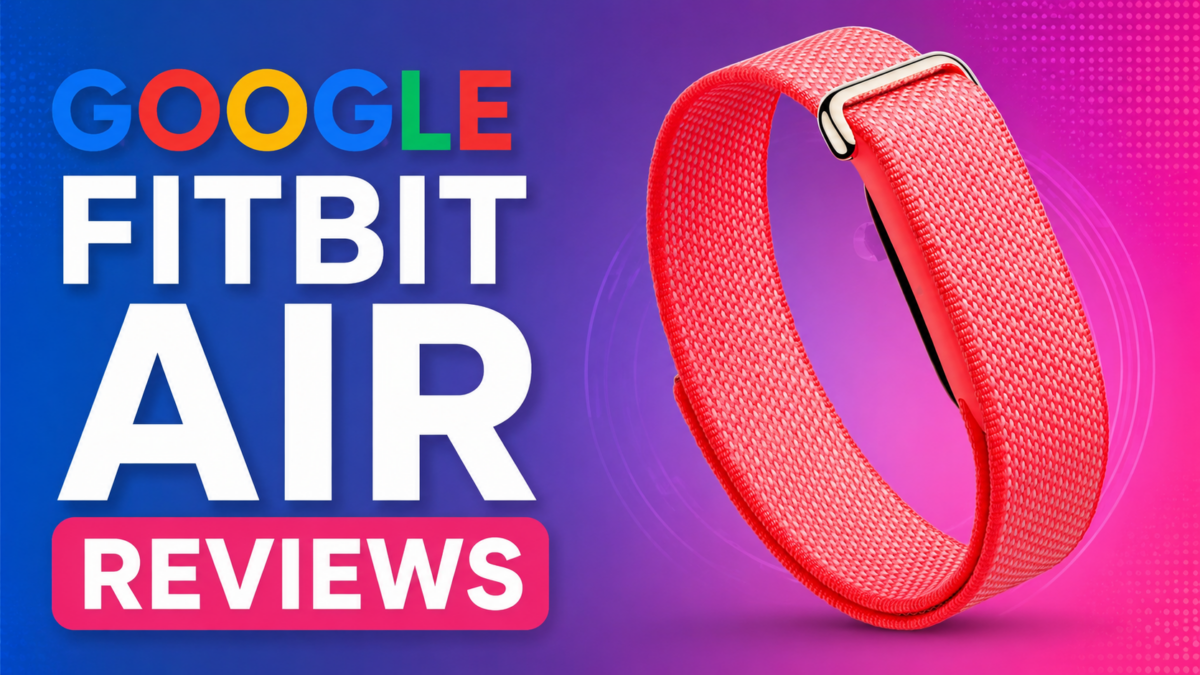
Google started shipping the Fitbit Air in late May 2026, and the first batch of verified-purchase reviews is already in from buyers in the US, UK, Germany, and Italy ( Source: Amazon ). The screenless tracker has landed with a sharply divided response — owners broadly agree it’s the most comfortable band they’ve worn, but a chunk of early units arrived with charging and pairing faults, and almost everyone has something to say about the companion app.
This roundup pulls together what actual buyers reported in their own reviews across the first few days of availability. It’s a snapshot of early sentiment, not a verdict — early-batch hardware and day-one software tend to change fast.
Note: This article summarizes Amazon verified-purchase reviews of the Google Fitbit Air posted by buyers in the US, UK, Germany, and Italy in the days after its late-May 2026 launch. It reflects individual buyer opinions and early-batch experiences, which may not represent the device’s typical performance. Software behaviour and hardware quality often change after launch — verify current details against Google’s official channels.
The One Thing Almost Everyone Agrees On: You Forget It’s There
The single most repeated line across reviews, in every region, is how little buyers notice the Fitbit Air on the wrist.
Owners describe it as “so light that I almost always forget I have it on,” “very comfy on the wrist,” and “weighs nothing — you will forget it is even there.” One reviewer coming from “the highest tier Apple Watch” said the fit was “perfect,” called it “very light, non-obtrusive, doesn’t rub or get hot,” and noted it’s narrow enough that it doesn’t pinch when the wrist flexes.
That comfort feeds directly into the use case buyers keep citing: sleep tracking. Several said this is the first wearable they can actually sleep in. “Finally can wear this to track my sleep without a bulky watch being too uncomfortable,” one US owner wrote. A UK buyer summed up the appeal as “light weight, put it on and forget about it.”

Fitbit Google Air - Screenless Activity Tracker - Berry
by Fitbit
Sold by Amazon.com #4 in Activity & Fitness TrackersRelated products


Screenless by Design — and Buyers Are Genuinely Split
The Fitbit Air ships without a display, and reviews show that’s the most polarizing design decision Google made.
On one side: “No screen. No annoying glow. No alerts… You will forget it is even there.” Another framed it as a feature for unplugging — “If you want to step away from notifications, this screenless tracker is what you need.” A German reviewer echoed that, saying they like not being “constantly pulled out of what I’m doing” by a buzzing wrist.
On the other side, the lack of a screen is a deal-breaker for some. “Screenless? Why? How would one see their heart rate while exercising?” one buyer asked. A five-star reviewer who otherwise loved it still admitted they “kind of miss in-workout stats right on my wrist.”
Setup, Syncing and the Google Health App
For buyers who got a working unit, setup drew consistent praise. Reviews describe it as “a seamless set up,” “easy as can be,” and connecting “right up with the app.”
The standout for several owners was data migration. One reviewer said the Google Health app “synched all my data from Apple Health… all my workouts and the stats — including maps — now in Google,” and that linking healthcare records was “easy as can be.” Others praised the app’s “stats and graphs and data to the max” and called the interface “clean and easy to understand.”
Accuracy feedback was mixed but leaned positive among working units. Buyers who cross-checked against an Apple Watch or a Garmin reported heart rate and step data that was “very similar” and “accurate and aligned between both” after a day of testing. Multiple reviewers noted the device needs time to calibrate baseline vitals and sleep — “it does take time for it to calibrate your normal vitals and sleep, so keep that in mind.”
The Gemini Coach and the Free Premium Trial
Google bundles a multi-month Premium trial with the Fitbit Air, and the AI coaching feature won over some skeptics.
“I thought the Gemini coach would be gimmicky but it’s surprisingly useful,” one buyer wrote. Another described the experience as “like having a little conscience that I can talk to and get advice from,” and called the three free months of Premium a “HUGE bonus.” A German reviewer was blunter about the trade-off: the device “delivers good baseline data,” but “the full potential — especially the AI-based coaching — only opens up with an active subscription.” At least one owner said they’ll drop Premium once the trial ends.
The Complaints: Defective Units and Charging Trouble
Not every box delivered a working device. A visible share of early reviews report dead-on-arrival hardware.
“Defective out of the box,” one US owner wrote. “Like many that received the early device, mine won’t charge. Tried multiple outlets and plugs. No dice.” A one-star reviewer described steps as inaccurate, heart-rate tracking as “intermittent,” and sleep tracking as not working at all — and said the unit wouldn’t even restart: “no way to restart from the app, no physical buttons on the device itself.” Their advice was to wait: “Don’t buy this until maybe 2027.”
Pairing and Google Account Headaches
The other cluster of one-star reviews has nothing to do with the hardware and everything to do with software gatekeeping.
Several buyers couldn’t pair the device at all. One reported it “won’t pair with my pixel phone” even after contacting Google support; a UK owner said it “won’t connect to my Samsung S24” despite following every instruction.
The most detailed complaint is about Google accounts. One buyer said they couldn’t use the tracker with their existing personal Gmail and were forced to create a new one. Another, trying to set it up for their children, found the Fitbit Air “incompatible with Google’s own Family Link supervised accounts” — noting the irony that Google owns both products. Children under 13 reportedly can’t use it, and supervised teen accounts can’t either, leaving workarounds as the only path. The reviewer flagged that there’s “no warning on the box” and “no note at point of sale” about the limitation.
The USB-C Charger Surprise
A smaller but repeated gripe: the charging cable caught buyers off guard.
Multiple reviewers pointed out that the included charger is USB-C, not standard USB-A — “just wanted anyone without a usb-c plug-in to be aware.” At least one is now buying adapters, and another wished Google had simply standardized on USB-C end to end rather than shipping “another unique charging cable right when everyone was going to one type.” The charger also doubles as the only way to restart the device, since there are no physical buttons on the band itself.
The App Is the Most Common Criticism
Even among happy owners, the Google Health app drew the most consistent “needs work” feedback — and one buyer made it the entire point of their review.
“Device is great, app is weak, and the app is where screenless trackers need to focus,” a four-star UK reviewer wrote. They flagged in-workout info as “extremely minimal” and gave a specific example: a 30-minute strength session that the app logged as “11 mins” because only that portion was spent in a higher heart-rate zone. A US buyer who compared data against an Apple Watch said the app “is still a bit glitchy” after one day and hoped Google would fix it. The common thread: buyers expect the software to improve quickly via updates.
Small Misses Buyers Flagged
Beyond the big themes, reviewers called out a handful of smaller gaps:
- Haptics are faint. A UK buyer warned the vibration motor is “VERY gentle” because the device is so small — “if you are planning to use this to wake you from sleep, you may find it lacking.”
- No GPS. An Italian reviewer who otherwise loved it lamented “the absence of integrated GPS.”
- Limited band options at launch. One US owner with larger wrists noted there were no longer-band options available at launch, which “surprised me.”
- A learning curve. A new owner said “there is a bit of a learning curve to know where everything is,” though they expected to sort it out.
FAQ / Common Questions
Does the Google Fitbit Air have a screen?
No. It’s a screenless tracker by design. Buyers are divided on this — some love the distraction-free experience and comfort for sleep, while others miss being able to glance at metrics like heart rate during a workout.
What charger does the Fitbit Air use?
Reviewers report it ships with a USB-C charging cable, not a standard USB-A one. Several buyers were caught out and recommend checking you have a USB-C port or adapter. The charger is also used to restart the device, as there are no physical buttons on the band.
Can children use the Google Fitbit Air?
According to buyer reports, the device does not work with Google Family Link supervised accounts. Reviewers said children under 13, and teens on supervised accounts, were unable to use it without workarounds — and that there’s no warning about this on the packaging.
How is the battery life?
Some early buyers reported the device tracking toward the advertised seven days of use, meaning no daily charging for most owners.
How does it compare to Whoop?
Multiple reviewers brought up Whoop directly, framing the Fitbit Air as the cheaper option — particularly because core tracking doesn’t require an ongoing subscription, unlike Whoop. However, Whoop has been here for a while, hence there would be a lot of features the Whoop does better than the Fitbit Air at the time of writing.
Popular Fitbit Air Youtube Reviews to check out
Disclaimer: This post summarizes publicly posted customer reviews for informational purposes. It is not affiliated with or endorsed by Google or Fitbit.