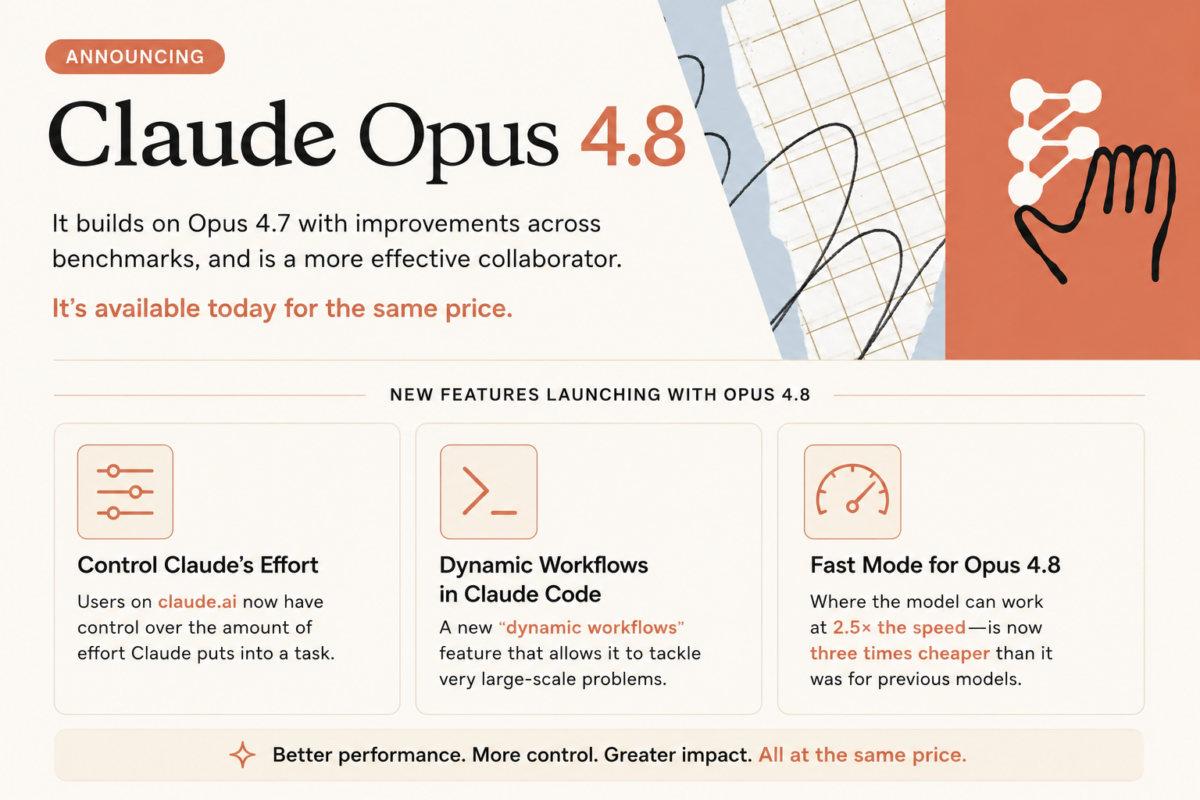
Anthropic has announced Claude Opus 4.8, an upgrade to the Opus model line that builds on Opus 4.7 with improvements across coding, agentic tasks, reasoning, and practical knowledge work. The model is available today at the same pricing as Opus 4.7: $5 per million input tokens and $25 per million output tokens for standard usage. Fast mode pricing drops to $10 per million input tokens and $50 per million output tokens — three times cheaper than fast mode was for previous Opus models.
Key additions include improved honesty and uncertainty flagging, Dynamic Workflows in Claude Code, effort control on claude.ai, and mid-task system prompt updates via the Messages API.
The release lands alongside several platform-level updates, including access to claude.ai Cowork and a new Messages API feature that lets developers update Claude’s instructions mid-task without breaking the prompt cache.
Quick Links
What Changed in Opus 4.8
One of the headline changes Anthropic highlights is honesty. The company notes that Opus 4.8 is around four times less likely than Opus 4.7 to let flaws in generated code pass without flagging them. Early testers describe the model as more likely to surface uncertainties rather than assert progress it hasn’t made — a pattern sometimes called “sycophantic confidence” in AI evaluations.
Anthropic’s Alignment team assessed the model before release and concluded it “reaches new highs on our measures of prosocial traits like supporting user autonomy and acting in the user’s best interest.” Rates of misaligned behavior — including deception and cooperation with misuse — are described as substantially lower than Opus 4.7 and comparable to Claude Mythos Preview, currently the company’s most safety-assessed model.
Benchmark results across coding, agentic performance, reasoning, and knowledge tasks show improvements over Opus 4.7. Detailed evaluation figures appear in the Claude Opus 4.8 System Card.
Dynamic Workflows in Claude Code
Dynamic Workflows is a new research preview feature in Claude Code that expands the scale of tasks Claude can handle within a single session. Claude plans the work, then runs hundreds of parallel subagents — each handling a piece of the larger problem — and verifies outputs before reporting back.
Anthropic’s stated example use case is codebase-scale migrations: moving hundreds of thousands of lines of code from kickoff to merge, using the existing test suite as the quality bar. The feature uses Opus 4.8 as its backbone, and the agents can run for longer sessions than prior versions allowed.
Dynamic Workflows is available in Claude Code for Enterprise, Team, and Max plan subscribers.
Effort Control on claude.ai
A new effort control appears alongside the model selector on claude.ai and Cowork. Users can select how much computational effort Claude applies to a given response:
- Lower effort — faster responses, slower rate limit consumption
- Default (high effort) — Anthropic’s recommended balance of quality and speed
- Extra / Max — more tokens spent for better results on difficult tasks or long-running asynchronous work
In Claude Code, the effort levels map to high, xhigh, and max. Anthropic has raised rate limits in Claude Code to accommodate higher token usage at elevated effort levels. The effort control is available across all plans.
Opus 4.8 defaults to high effort. Anthropic notes that on coding tasks, this effort level spends a similar number of tokens as Opus 4.7’s default while delivering better performance.
Messages API — System Prompts Mid-Task
The Messages API now accepts system entries inside the messages array. Previously, developers could only set system instructions at the start of a conversation. The new capability lets a developer update Claude’s instructions — permissions, token budgets, environment context — at any point during an agent run, without breaking the prompt cache or routing the update through a user turn.
This is aimed at agentic use cases where conditions change during task execution.
What Comes Next — Mythos-Class Models
Anthropic notes that Claude Mythos Preview is currently in limited deployment for cybersecurity work through Project Glasswing. The company describes Mythos-class models as having higher intelligence than Opus, but requiring stronger cyber safeguards before general release. Anthropic says it is making progress on developing those safeguards and expects to bring Mythos-class models to all customers “in the coming weeks.”
Availability and Pricing
Claude Opus 4.8 is available today via the Claude API using the model ID claude-opus-4-8. It is also accessible on claude.ai across all plans.
| Usage Type | Input (per 1M tokens) | Output (per 1M tokens) |
|---|---|---|
| Standard | $5 | $25 |
| Fast Mode | $10 | $50 |
Fast mode pricing is unchanged in dollar terms from the listed rates above, but Anthropic notes this represents a 3× cost reduction compared to fast mode pricing on previous Opus versions.
FAQ / Common Questions
When is Claude Opus 4.8 available?
It launched on May 28, 2026 and is available immediately via the Claude API (claude-opus-4-8) and on claude.ai.
What is the price of Claude Opus 4.8?
Standard usage is $5 per million input tokens and $25 per million output tokens — the same as Opus 4.7. Fast mode is $10 per million input tokens and $50 per million output tokens, which is three times cheaper than fast mode was on prior Opus models.
What are Dynamic Workflows in Claude Code?
Dynamic Workflows is a research preview feature that lets Claude plan large tasks and run hundreds of parallel subagents within a single Claude Code session. It targets large-scale work like codebase migrations. Available for Enterprise, Team, and Max plan users.
What is effort control on claude.ai?
A new setting that lets users choose how much computational effort Claude applies to a response. Lower effort is faster and uses less of your rate limit; extra and max effort spend more tokens for better results on hard tasks.
What is Claude Mythos Preview?
Anthropic describes it as a model with higher intelligence than Opus, currently deployed to a small number of organizations for cybersecurity work under Project Glasswing. Broader availability is expected in the coming weeks.
Note: Details above are based on Anthropic’s announcement on May 28, 2026, and are subject to change. Final feature availability, rollout timing, and supported plans may vary. Verify against Anthropic’s official channels before relying on any specific detail.
Disclaimer: This post summarizes an Anthropic product announcement for informational purposes. It is not affiliated with or endorsed by Anthropic.