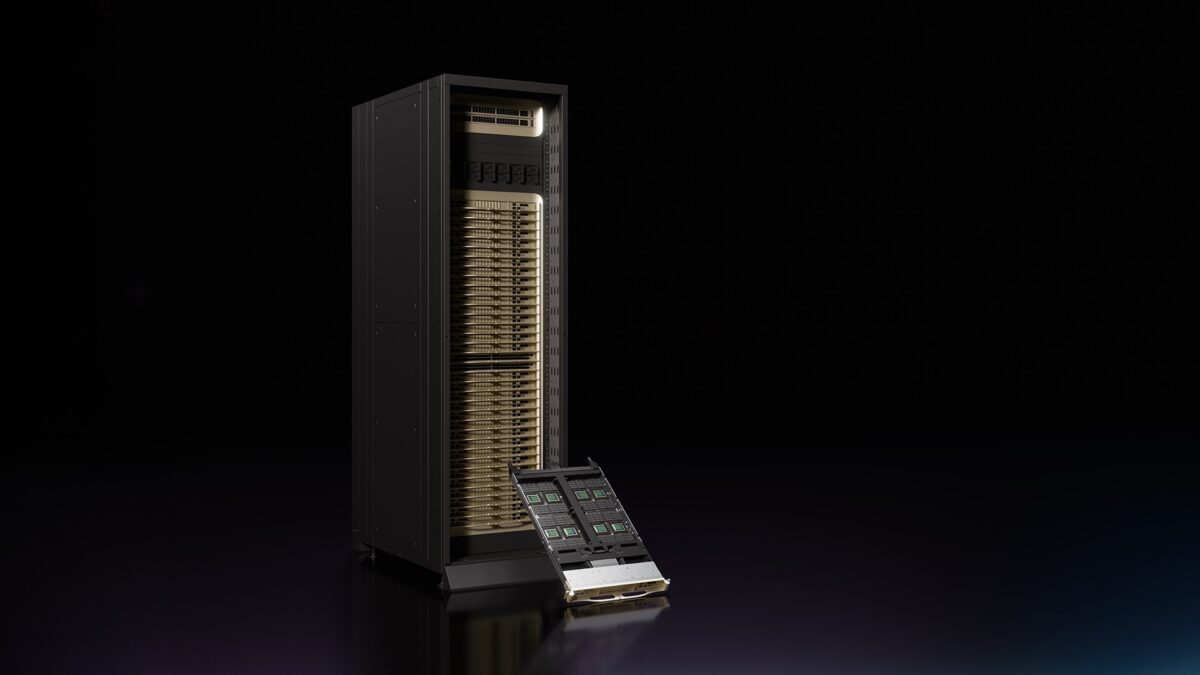
NVIDIA has unveiled Vera, its first CPU built specifically for AI agents. Now in full production, Vera is a new class of processor designed to handle the CPU-side workloads that modern AI factories generate — agentic task execution, reinforcement learning, code compilation, Python and Java runtimes, and data processing pipelines. The announcement was made at NVIDIA GTC Taipei.
Key capabilities include 1.8x faster task completion compared with x86 CPUs, a custom Olympus CPU core engineered for AI factory workloads, 88 cores with Spatial Multithreading, and up to 1.2TB/s of LPDDR5X memory bandwidth. Vera also serves as the host CPU for NVIDIA’s Vera Rubin GPU platforms via second-generation NVLink-C2C, delivering up to 1.8TB/s of coherent CPU-to-GPU bandwidth.
NVIDIA positions Vera as the successor to its Grace CPU line, which has shipped nearly 2.5 million units to date. The shift in AI factory economics — from cores per dollar to tokens per dollar — is driving the need for CPUs that can complete orchestration, tool use, and sandbox execution faster and at greater concurrency.
Quick Links
Olympus Core — NVIDIA’s Custom CPU Architecture
At the heart of Vera is Olympus, a custom CPU core NVIDIA engineered specifically for the workloads that sit on the critical path of AI agent execution. These include Python runtimes, sandboxed code execution, orchestration logic, and analytics pipelines — the steps that happen between GPU kernel calls and determine how quickly agents can complete tasks.
Vera features 88 Olympus cores paired with Spatial Multithreading, a technique for processing more instructions across large numbers of concurrent environments, queries, and data processing tasks simultaneously. The LPDDR5X memory subsystem delivers up to 1.2TB/s of bandwidth, reducing the time agents spend waiting on CPU-bound steps and keeping accelerators active.
According to benchmarks from Phoronix, Vera delivered the fastest overall performance across agentic workloads — including code compilation, Python, Java, and database processing — compared with competing processors tested.
Vera in the AI Factory — From Standalone Servers to GPU-Coupled Systems
Vera is designed to run across the entire AI factory stack, not just in one configuration. It powers three distinct system types:
- Standalone Vera CPU servers — standard CPU-only configurations for data processing, orchestration, and agentic AI workloads, offered by Dell Technologies, HPE, Lenovo, and Supermicro as an alternative to x86
- NVIDIA Vera Rubin systems — Vera serves as the host CPU tightly coupled to Rubin GPUs via second-generation NVLink-C2C, providing up to 1.8TB/s of coherent bandwidth between processor and GPU
- NVIDIA Vera BlueField-4 STX — integrates Vera with high-performance networking, storage acceleration, and in-silicon security for AI-native storage platforms
Vera also extends NVIDIA Confidential Computing at rack scale, protecting agentic workloads end-to-end across the data center.
Deployment Plans — AI Labs, Hyperscalers, and NYSE
A broad set of customers are planning to adopt Vera for production workloads.
Anthropic, the company behind Claude, is evaluating Vera for CPU-intensive agentic workloads. James Bradbury, head of compute at Anthropic, noted that scaling compute is an important accelerant for model growth and called Vera a promising part of the ecosystem for agentic workloads.
Oracle Cloud Infrastructure is planning to deploy Vera CPUs to support high-throughput reasoning and data processing across next-generation AI environments. Mahesh Thiagarajan, EVP of OCI, described it as the next frontier in hyperscale AI supercomputing.
NYSE is collaborating with Redpanda and HPE to use Vera CPUs to scale capacity and further optimize latency across its market infrastructure, which processes more than 1.1 trillion messages per day.
Other customers exploring or planning to deploy Vera include OpenAI, SpaceXAI, ByteDance, CoreWeave, Lambda, Nebius, Nscale, and Cloudflare, among others.
System Builders and Cloud Providers
Vera CPUs are available in two form factors: dense, liquid-cooled racks for large-scale agentic AI and reinforcement learning environments, and flexible two-socket air-cooled systems for enterprise, cloud, data processing, and AI factory deployments.
Infrastructure providers building Vera-based systems include Aivres, ASRock Rack, ASUS, Compal, Dell Technologies, Foxconn, GIGABYTE, HPE, Hyve Solutions, Inventec, Lenovo, MiTAC Computing, MSI, Pegatron, Quanta Cloud Technology (QCT), Supermicro, Wistron, and Wiwynn.
Cloud service providers planning to offer Vera CPU capacity include Akamai, ByteDance, Cloudflare, CoreWeave, Crusoe, Lambda, Nebius, Nscale, Oracle Cloud Infrastructure, Redpanda, Starburst, Together AI, and Vultr.
Rollout Timing — What’s Live When
| Phase | When | Scope |
|---|---|---|
| Production | Now (announced at GTC Taipei 2026) | Vera CPU in full production |
| System availability | Fall 2026 | Vera-based servers from system builders and cloud partners |
FAQ / Common Questions
What is NVIDIA Vera and what does it do?
Vera is NVIDIA’s first CPU designed specifically for AI agent workloads. It handles the CPU-intensive tasks in AI factories — orchestration, code execution, Python and Java runtimes, data processing — and is built to complete these steps 1.8x faster than x86 processors, keeping GPU accelerators busy and improving agent throughput.
What makes Vera different from NVIDIA’s Grace CPU?
Vera is built on Olympus, a new custom CPU core NVIDIA engineered from the ground up for AI agent execution. Grace focused on general high-performance computing in data centers; Vera targets the token-per-dollar economics of AI factories, with Spatial Multithreading and LPDDR5X memory bandwidth optimized for concurrent agent environments.
Which companies are planning to use NVIDIA Vera?
AI labs including Anthropic, OpenAI, and SpaceXAI are evaluating or planning to adopt Vera. Hyperscalers ByteDance, CoreWeave, Lambda, Nebius, Nscale, and Oracle Cloud Infrastructure are also among the planned deployments. NYSE is using Vera in collaboration with HPE and Redpanda for its market infrastructure.
When will Vera-based servers be available?
Vera systems from system builders and cloud partners are expected to be available starting Fall 2026.
What is Vera BlueField-4 STX?
It is a processor that integrates the Vera CPU with high-performance networking, storage acceleration, and in-silicon security, creating a secure-by-design AI-native data platform for storage workloads in AI factories.
Note: Details above are based on NVIDIA’s announcement at GTC Taipei 2026, and are subject to change. Final feature availability, rollout timing, and supported configurations may vary. Verify against NVIDIA’s official channels before relying on any specific detail.
Disclaimer: This post summarizes an NVIDIA product announcement for informational purposes. It is not affiliated with or endorsed by NVIDIA or any manufacturer mentioned.