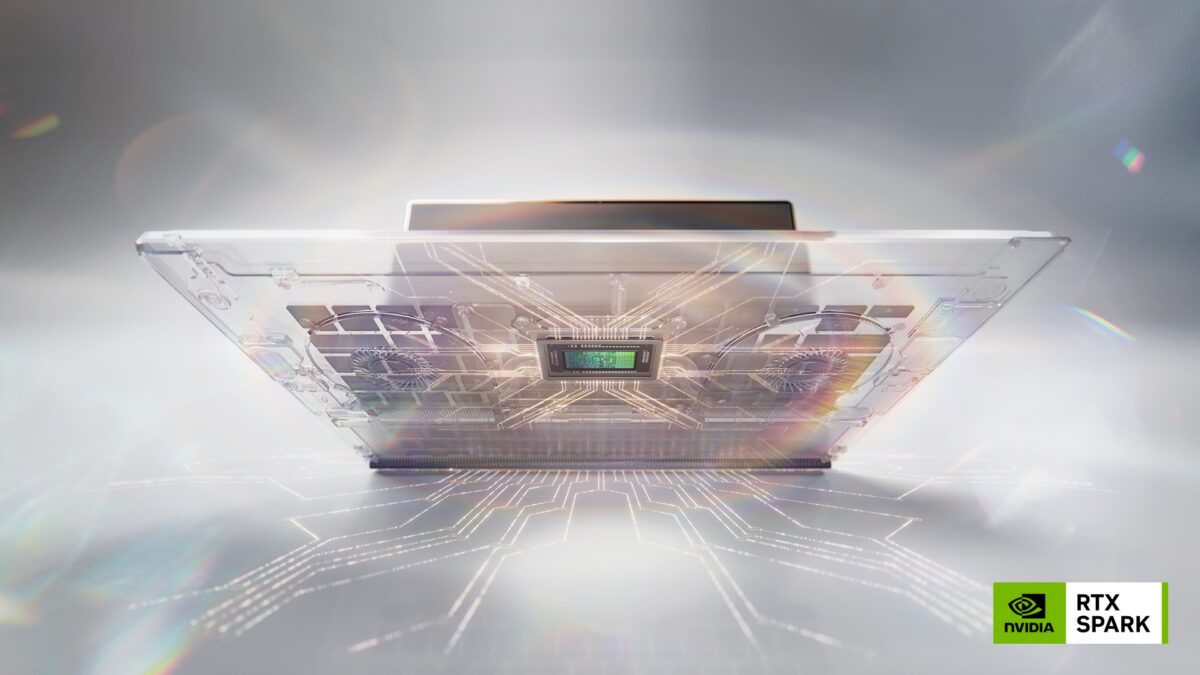
NVIDIA has unveiled RTX Spark, a new superchip designed to bring personal AI agents, creative workloads, and gaming to slim Windows laptops and compact desktop PCs. The announcement was made at NVIDIA GTC Taipei, alongside a collaboration with Microsoft to deliver a native Windows platform for on-device agents. RTX Spark-powered devices from ASUS, Dell, HP, Lenovo, Microsoft Surface, and MSI are expected to arrive this fall, with models from Acer and GIGABYTE following.
RTX Spark combines an NVIDIA Blackwell RTX GPU with 6,144 CUDA cores and fifth-generation Tensor Cores with a 20-core NVIDIA Grace CPU, connected via NVLink-C2C chip-to-chip interconnect. The superchip delivers 1 petaflop of AI compute and supports up to 128GB of unified memory. MediaTek collaborated with NVIDIA on the custom CPU design, contributing to power efficiency and connectivity.
The chip targets three simultaneous use cases: running 120B-parameter LLMs locally with 1 million token context, handling creative workflows including 12K 4:2:2 video editing and 90GB+ 3D scene rendering, and playing AAA games at 1440p at over 100 frames per second with ray tracing, DLSS, and Reflex.
Related blog to check out: NVIDIA’s Vera CPU for AI Agents — 1.8x Faster Than x86, 88 Olympus Cores, Adopted by Anthropic, OpenAI, Oracle Cloud, Dell, HPE, and More.
Quick Links
Blackwell GPU + Grace CPU — The RTX Spark Architecture
RTX Spark is built around two interconnected components on a single package. The GPU side carries the NVIDIA Blackwell RTX architecture with 6,144 CUDA cores, fifth-generation Tensor Cores with FP4 precision, and a new Blackwell video decoder capable of handling 12K 4:2:2 content. The CPU side is a 20-core NVIDIA Grace processor, co-designed with MediaTek for efficiency and connectivity in thin-and-light form factors.
The two dies communicate via NVLink-C2C, NVIDIA’s chip-to-chip interconnect, which enables a single unified memory pool of up to 128GB accessible by both the CPU and GPU simultaneously. This unified memory architecture is what allows RTX Spark to run frontier-class language models locally — models that would otherwise require GPU memory and system RAM to be managed separately.
The full NVIDIA AI and graphics stack ships with RTX Spark: CUDA, TensorRT, OptiX, DLSS, Reflex, and G-SYNC are all supported.
Windows-Native Agents — NVIDIA OpenShell and Microsoft Security Primitives
NVIDIA and Microsoft are partnering to bring a secure, on-device agent platform to Windows. The collaboration centers on two components.
New Windows security primitives provide identity, containment, policy, and end-to-end security for agents running natively on the device. These primitives are being built into Windows and are designed to let agents execute tasks across applications, run code, and handle files while remaining under user control.
NVIDIA OpenShell is a runtime layer that adds additional policy controls on top of the Windows primitives. It lets users define what agents can and cannot access, intelligently routes queries to local models based on privacy policies, and can strip or mask personal information before any query is sent to a cloud model.
Agent developers OpenClaw and Hermes Agent (from Nous Research) are among the first to adopt OpenShell and the Microsoft security primitives in their Windows apps. From the Windows taskbar, users will be able to invoke agents that can execute tasks inside applications, run cross-app workflows, generate images and video, write code, and search local files semantically.
Microsoft CEO Satya Nadella described the goal as delivering “unmetered intelligence to every home and every desk with Windows.”
Creative Capabilities — Adobe Rearchitects Premiere and Photoshop for RTX Spark
Adobe is rebuilding Photoshop and Premiere specifically for RTX Spark, targeting up to 2x faster AI, editing, coloring, and effects performance compared with existing workflows.
Adobe Premiere is getting a new video pipeline that uses RTX Spark’s unified memory, Blackwell GPU, and TensorRT software stack. The reworked pipeline targets real-time performance for editing and color correction, GPU-accelerated AI effects, and more efficient rendering of complex timelines. Adobe Substance 3D Painter and Stager will also run natively on RTX Spark.
Adobe Photoshop’s next-generation engine is being optimized for GPU-accelerated compositing, live filters, high dynamic range workflows, and natural brushing. The engine is built to use TensorRT. Both Premiere and Photoshop will also integrate with Windows agents, allowing creators to offload tasks to an on-device AI assistant from within the apps.
Firefly-powered Generative Fill in Photoshop and Generative Extend in Premiere are among the tools that will see direct performance gains from RTX Spark. Updates are expected to roll out alongside RTX Spark device availability in fall 2026.
Other software partners include Blackmagic Design, Blender (with DLSS 4.5 Ray Reconstruction coming to version 5.3), ComfyUI (which gains 4K AI video generation via RTX Video with 4x Frame Generation), OTOY Octane, CapCut, and llama.cpp for optimized local model inference.
Gaming on RTX Spark — DLSS 4.5, Ray Tracing, G-SYNC
For gaming, RTX Spark supports AAA titles at 1440p and over 100 frames per second with ray tracing, DLSS, and Reflex. RTX technology is active in over 1,000 games and applications, and over 100 Windows software providers are embracing the platform.
New RTX capabilities coming with RTX Spark include DLSS 4.5 Ray Reconstruction, which uses a second-generation transformer model and is coming to Blender 5.3 and dozens of games. RTX Video with 4x Frame Generation is coming to ComfyUI.
Game developers embracing the platform include KRAFTON, NetEase (NARAKA: BLADEPOINT), Remedy Entertainment, Riot Games, and XBOX. NetEase noted that RTX Spark enables its titles to run as intended on ultrathin, high-performance laptops.
Device Form Factors — Slim Laptops and Compact Desktops
RTX Spark laptops are engineered to be as slim as 14mm and as light as three pounds, available in 14- to 16-inch sizes. The chassis uses precision-machined aluminum. Displays are color-accurate tandem OLED panels with NVIDIA G-SYNC, targeting both creative color work and gaming visuals. All-day battery life is a stated design goal for the laptop line.
Compact RTX Spark desktop PCs are also in development, positioned for agentic AI workloads, creative production, gaming, and everyday productivity in a small-footprint chassis.
Named devices and OEM commitments:
- Dell XPS 16 Creator Edition — RTX Spark with large unified memory, designed for creators
- HP OmniBook — described as one of the thinnest RTX Spark laptops
- Microsoft Surface Laptop Ultra — targeting creators, developers, and engineers
- Additional designs from ASUS, Lenovo, MSI, with Acer and GIGABYTE following
NVIDIA DGX Station for Windows will extend the Blackwell architecture to enterprise developers who need a deskside AI supercomputer for running agents at scale.
Rollout Timing — What’s Live When
| Phase | When | Scope |
|---|---|---|
| Announcement | GTC Taipei 2026 (now) | RTX Spark superchip unveiled |
| Windows agent developer details | Microsoft Build, June 2–3, 2026 | Security primitives, OpenShell for developers |
| RTX Spark devices available | Fall 2026 | Laptops and compact desktops from ASUS, Dell, HP, Lenovo, Microsoft Surface, MSI |
| Acer and GIGABYTE models | After fall 2026 | Additional OEM devices to follow |
| Adobe app updates | Alongside fall 2026 RTX Spark availability | Premiere, Photoshop, Substance 3D updates |
FAQ / Common Questions
What is NVIDIA RTX Spark?
RTX Spark is a superchip that combines an NVIDIA Blackwell RTX GPU and a 20-core NVIDIA Grace CPU on a single package, connected via NVLink-C2C. It is designed for Windows laptops and compact desktops, targeting AI agent execution, creative workloads, and gaming in thin, portable form factors.
How much AI compute and memory does RTX Spark offer?
The superchip delivers 1 petaflop of AI compute and supports up to 128GB of unified memory shared between the GPU and CPU. This unified memory pool allows it to run 120-billion-parameter language models locally with 1 million token context.
Which laptops and PCs will use RTX Spark?
RTX Spark-powered devices are confirmed from ASUS, Dell (XPS 16 Creator Edition), HP (OmniBook), Lenovo, Microsoft Surface (Surface Laptop Ultra), and MSI for fall 2026. Acer and GIGABYTE will follow with additional models.
What is NVIDIA OpenShell?
OpenShell is a runtime for on-device agents that works alongside new Windows security primitives from Microsoft. It lets users set policies for what agents can access, routes queries to local or cloud models based on privacy preferences, and masks personal information before sending queries externally.
Will Adobe apps like Photoshop and Premiere work differently on RTX Spark?
Adobe is rebuilding both apps specifically for RTX Spark. The new engines use TensorRT, the Blackwell GPU, and unified memory to target up to 2x faster AI and graphics performance. Updates are expected to roll out when RTX Spark devices ship in fall 2026.
When will RTX Spark devices be available?
Laptops and compact desktops powered by RTX Spark are expected to be available from system builders and cloud partners starting fall 2026.
Note: Details above are based on NVIDIA’s announcement at GTC Taipei 2026 and are subject to change. Final feature availability, rollout timing, and supported devices may vary by region. Verify against NVIDIA’s and the respective manufacturers’ official channels before relying on any specific detail.
Disclaimer: This post summarizes an NVIDIA product announcement for informational purposes. It is not affiliated with or endorsed by NVIDIA, Microsoft, Adobe, or any device manufacturer mentioned.